





Courageous Leadership
When the Stars Align: Leading with Faith, Purpose and Partnership
By Thomas Evans, PhD, President, University of the Incarnate Word (TX)
Over the course of my 27 years in higher education leadership, I have found that every so often opportunities emerge that feel at once unexpected, yet providential. Such moments are rare — the wind must be at your back and both stars and strategies must align. When occasions like this arise, leaders are faced with a choice: stay the course, or chart a new passage in the pursuit of greater rewards and transformative opportunities?
As the president of the University of the Incarnate Word (UIW) and a man whose faith is very important to him, I believe deeply in the concept of divine timing. So, when I connected with fellow presidents of Catholic universities that shared so much of UIW’s outlook and who were seeking to build something meaningful and mutually beneficial, it seemed destined.
So, together, we four presidents embarked.
Our goal was to establish an alliance unlike any our institutions had forged before. We sought out our leaders and Mission leaders to identify points of convergence in our academic programs and map out new pathways for learning opportunities.
The result is CHARISM (Catholic Higher Education Alliance of Rising Institutions in Service and Mission) — a collaboration between the University of the Incarnate Word, Dominican University in Chicago, the University of Mount Saint Vincent in New York, and Universidad del Sagrado Corazón in San Juan, Puerto Rico.
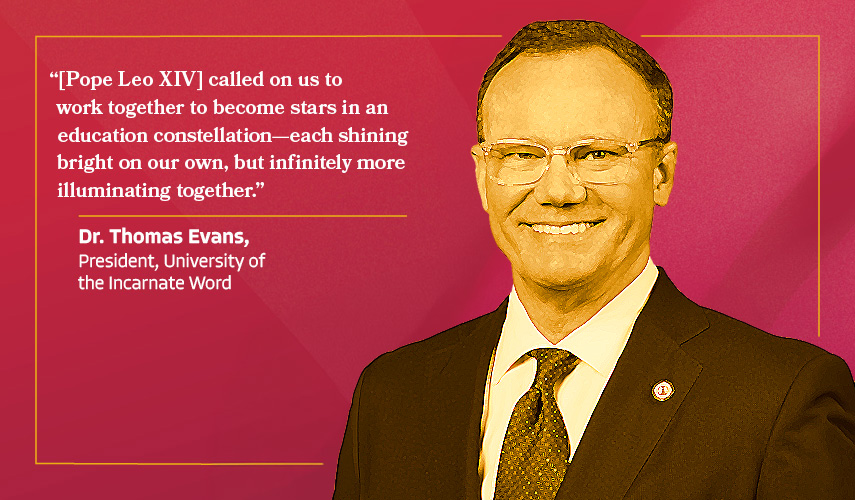
About a month before we were set to announce the formation of our alliance on the UIW campus, Pope Leo XIV issued his Apostolic Letter “Drawing New Maps of Hope,” which unveiled a bold new mandate for Catholic schools and universities. He called on us to work together to become stars in an education constellation — each shining bright on our own, but infinitely more illuminating together.

[Pope Leo XIV] called on us to work together to become stars in an education constellation — each shining bright on our own, but infinitely more illuminating together.
~Thomas Evans, President, University of the Incarnate Word

Beyond offering the most profound confirmation of our work, the Holy Father’s directive defined our purpose: now that the stars have aligned for us, we ourselves must light the way for our students. Our constellation will provide the light that they need to find greater opportunity and access to the things they need to succeed. Of course, it will take courage and creativity, as well as thoughtful reflection as we seek deeper affinities through a lens of possibility. Nevertheless, I believe wholeheartedly in the potential for CHARISM to transform.
I also believe that this is the direction that all higher education institutions, not only Catholic universities, are headed. More and more, we will see a shift not toward isolation, but toward interconnectedness, collaboration and shared strength.
Partnership with Purpose
I have long been drawn to forging somewhat unconventional partnerships. Earlier in my leadership career as an associate vice president, I was tasked with working with the Ballet Austin to help forge a path for retiring dancers to attain higher education degrees. Ballet careers are often short, so these former dancers were relatively young, yet they possessed an incredible work ethic and a broad swath of experiences.
Our efforts paid off. The ballet dancers made great students and many of the young men and women found success in their second careers.
It was only one of the many partnerships I would work on, but it was certainly one of the most memorable—especially given the fact that it would later be expanded to include dancers from the Houston Ballet. From the experience, I extracted the central question that applied whether I was working with corporate members of Austin’s technology sector or developing international education models: Who does this partnership serve anyway?
That question took on new profundity when I became president of the University of the Incarnate Word.
Like many institutions, we were navigating a time of seismic change. Demographics were shifting, regional competition was increasing, and skepticism about the value of higher education was on the rise. To remain competitive, to ensure that we fulfilled our Mission, students simply needed more.
We were equipped to deal with the sea change before us. Our advantages were many: a deep commitment to students, an academic portfolio that reflected our own founding charism and regional need, and a global footprint that spanned from San Antonio, to elsewhere in South and Central Texas, to Mexico, and included a European Study Center in Strasbourg, France.
So, we set to work building more connections, both outside and within the University. We fostered deeper relationships between departments and schools, and created pathways across campuses and countries. We grew interdisciplinary clinical opportunities. We established new avenues that would allow students to obtain “triple degrees” recognized in three countries.
Still, I found myself asking: How can we do more? How can we build even stronger connections?
That question began to take form in early 2025 at a gathering of Catholic university presidents, where I connected with Dr. Glena Temple of Dominican University. Soon after, I would be introduced to Dr. Susan Burns of the University of Mount Saint Vincent. Not long after that, Gilberto Marxuach Torrós of Universidad del Sagrado Corazón would reconnect thanks to Dr. Donna Carroll, president of the Association of Catholic Colleges and Universities. Through a series of conversations — some planned, others serendipitous — we began to notice something important.
Our institutions, though geographically dispersed, shared deep affinities. Each university was rooted in the Catholic faith, had been founded by women religious, served diverse student populations in large metropolitan areas and had been designated Hispanic-Serving Institutions. Moreover, we possessed complementary areas of distinction, notably in healthcare and international education. Just as importantly, we were led by individuals who believed that higher education must evolve and create new, innovative ways to serve our students even better.
More and more, we will see a shift not toward isolation, but toward interconnectedness, collaboration and shared strength.
~Thomas Evans, President, University of the Incarnate Word
From Affinity to Action
Within less than a year, CHARISM was established. In higher education, that’s extraordinary. The reason it moved so quickly is simple: alignment. We had the right institutions, the right leaders and a shared willingness to act. There was no need to convince one another that collaboration mattered — we already believed it. The question wasn’t if we should do this, but how we could do it, and above all, how we could do it well.
Our first task was not to build something from scratch, but, naturally, to align our strengths. One institution had a pre-physician assistant program but no graduate program; another had the graduate program but no pipeline. Together, we created a pathway. One institution had strength in bilingual education; another wanted to expand. Together, we scaled that capability.
Faculty began to collaborate, speaking at partner campuses and co-teaching courses. Shared academic pathways opened and began to take shape. Programs that would have taken years to develop independently were launched in a fraction of the time.
Our momentum was due in large part to our communities that embraced the project. Faculty and staff envisioned possibilities we hadn’t yet imagined and brought forward ideas we hadn’t considered. We invited our colleagues to San Antonio for the announcement and during our time together, we explored what could yet be done. When we met again in Puerto Rico, I remember seeing faculty members embrace like longtime colleagues, though they had only recently begun working together. In that moment, it became clear: we were growing opportunity and community.
This is not to suggest that establishing CHARISM was free from challenges. One of the most complex was communication. We were developing the model in real time while also bringing along faculty, administrators and leaders, often under the constraints necessitated by confidentiality. That required coordination and a deep respect for shared governance.
There were also moments of tension. People championed projects and wanted their programs included; they saw the potential and wanted to move quickly. Our role as leaders was to channel that enthusiasm in ways that our limited (but growing) capacities would allow.
What Courage Looks Like Now
If I were to offer advice to leaders at the beginning of this journey, it would start here: be open to bold ideas with unexpected partners. Then, with an open mind and an eye for possibilities, look for affinities. Find institutions that share your mission, your values and your commitment to students. Geography matters — but alignment is more important.
Once you have found your allies, invest in relationships. Carve out dedicated time for conversations, blue-sky thinking and strategy. Transparency builds trust and clarity of vision. Carve out more time for travel and face-to-face engagement. Technology can support collaboration, but it cannot replace the human connection that sustains it.
Above all, invite your community in. CHARISM is not an alliance of presidents: it is an alliance of institutions. Make sure your leaders, faculty and student formation teams have a hand in the careful development and stewardship of each opportunity that arises.
This is the stage we find ourselves in. We are only months into our formal alliance and while much work is behind us, we have much yet to do.
There are days when I step back and think, Are we really doing this? It feels, at times, almost surreal. Our foundation is the conviction that we must fully realize what we have started because of who we will serve. First and foremost, it will reach students who will access opportunities they might never have imagined. It will empower faculty to teach and collaborate in new ways. It will enable employers to engage with a broader, more diverse talent pool. Once again, we return to our shared purpose: to serve students, to transform lives and to contribute to the greater good.
Together, we create something that offers direction, meaning and new possibilities for others to follow.
~Thomas Evans, President, University of the Incarnate Word
A Constellation, Not a Collection
I shared early on that our alliance felt providential, that our institutions were meant to work with one another. As we continue to define and expand the opportunities we are building, I grow more convinced of this.
At its core, charism (and CHARISM) is both a gift and a calling. What we are discovering is that when institutions bring their strengths together rather than keeping them apart, something powerful happens. We move from being a collection of institutions to becoming a constellation in Pope Leo XIV’s celestian vision for Catholic education.
Each institution will continue to shine independently. But together, we create something that offers direction, meaning and new possibilities for others to follow. When the stars align, the future doesn’t just come into focus. It expands.

