





Courageous Leadership
The Courage to Be Yourself
By Stefani Hicswa, Ph.D.
Chancellor
Montana State University Billings (MT)
When I became a college president at 37 years old, I knew I was walking into a position of immense responsibility, but also profound opportunity. As a first-generation college student, one of the first Generation X presidents, and the first woman president at the institution, my journey has been as much about authenticity as it has been about leadership. This path has required courage — courage to embrace who I am, lead boldly, and set an example for others to do the same.

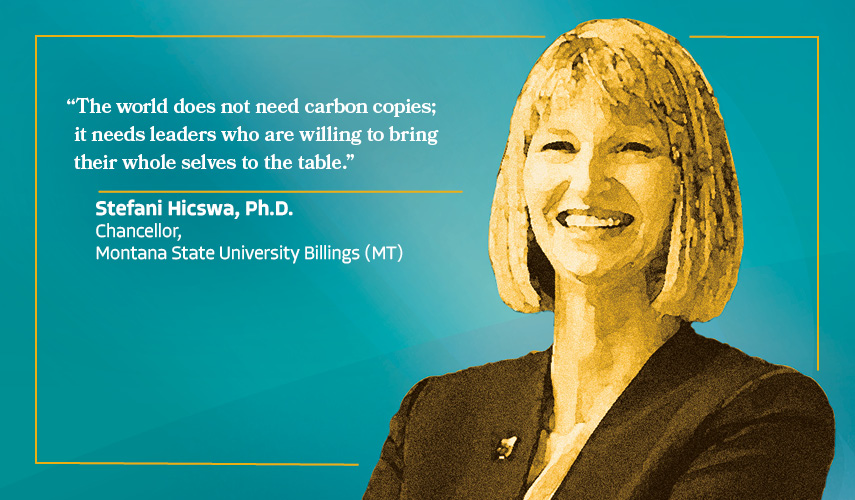
The world does not need carbon copies; it needs leaders who are willing to bring their whole selves to the table.
~Stefani Hicwa, Ph.D., Chancellor, MSU Billings

Authenticity is a word we hear often, but in practice, it is not always easy to embody. For me, authenticity starts with always being true to my values. Growing up in a small town in Montana, I learned the value of hard work, integrity, and resilience early. I grew up on a ranch where my father was the foreman, and I started working with him at a young age baling hay, feeding cows, and moving irrigation pipe. Even though I had a strong work ethic and good grades, my high school counselor discouraged me from applying for college because my family could not afford it.
Consequently, I took it upon myself to research scholarships and financial aid opportunities, learning that leadership in high school clubs and activities could improve my chances. Through sheer grit and determination, I graduated third in my class, earned a distinguished graduate award, and pieced together about twenty different scholarships to help pay for college. Once there, I worked multiple jobs to support my education and became the first person in my extended family to earn a college degree. It was not easy, but it was worth it, and in the process the leadership bug bit me.
These experiences taught me not only about leadership but also the power of resilience and the importance of belonging — a message I often share with students. Many of our students feel like imposters, uncertain if they truly belong in college. I tell them my story to demonstrate that no matter where they start, they have the potential for achievements bigger than they have ever dreamed. Like the professor in Dr. Tara Westover’s memoir, Educated, who told her, “It was always within you,” I remind students that they, too, have the ability to succeed despite the odds.
The Power of Vulnerability
One of the first lessons I learned navigating as a leader despite the odds was the importance of courage and self-awareness. Early in my career, as one of the youngest college presidents in the country, I thought that leadership meant projecting confidence at all times. Over time, I realized that being true to who I am and being vulnerable are just as important. Being a college president is too demanding to fake it. Authentic leadership is not about having all the answers; it is about being open to questions, admitting when you do not know something, and inviting others to join you in finding solutions. This mindset has allowed me to build trust with my team and to foster a culture where people valued and heard.
Being authentic also means leading with purpose. In my roles as president of Miles Community College and Northwest College, and as chancellor of MSU Billings, I worked to create a vision that reflects the needs and aspirations of the region. This has not always been easy. Change is hard, and often it requires making decisions that are not universally popular. As a leader, I have found that if I can articulate the “why” behind a decision and connect it to our shared mission, people are more likely to come on board. Authenticity does not mean everyone will always agree with you, but it does mean they will respect you for being honest and transparent.
As a woman leader, I have had to challenge stereotypes and break down barriers. There were times when I have been told to tone down my ambition or to conform to expectations that did not align with who I am. In those moments, I had to summon the courage to push back. I learned that staying true to my whole self is not just about personal integrity, it is also about paving the way for others. When I am authentic, I am not just leading; I am modeling what is possible for the next generation of leaders. When I host student dinners at the Chancellor’s Residence, students often ask how to become chancellor. I tell them the basics followed by, “if not you, then who? Someone must be chancellor when I retire.” If they can see me, knowing my story, they can be me, since my background is similar to theirs.
Work-Life Integration
In modeling what is possible for the next generation of leaders, I am open about the difficulties of juggling work and family. It has been one of the most challenging, yet rewarding, aspects of my leadership journey. Early in my first presidency, I discovered that work-life balance does not exist. It is not about perfection, instead it is all about integration. For example, when my children were young, I would prioritize being home for their bedtime routine, even if it meant having the courage to excuse myself early from evening events with my board chair. The time spent with my sons — reading to them and tucking them in — allowed me to decompress from the day and reconnect with what mattered most. On many nights, I would go to bed shortly after my children and wake up at 2:00 a.m. to tackle emails and plan for the day ahead. This unconventional schedule gave me quiet, focused time while ensuring I remained present for my family.
There have been numerous moments when my dual roles as mother and leader collided. One year, my legislative duties conflicted with my son’s birthday. My family traveled to the capital with me and my sons joined me in meetings with legislators. I also recall attending a fundraising event with my young children when my husband was out of town. Rather than seeing it as a challenge, I viewed it as an opportunity to integrate my family into my professional life. It was stressful but my sons charmed attendees and even helped share the college’s story in ways I never could. These experiences not only strengthened my connection with my children, but also demonstrated to others that leadership does not require sacrificing family. As a bonus, my children learned social skills that continue to benefit them to this day.
Technology has also played a pivotal role in maintaining work-life integration. Tools such as FaceTime have been invaluable, enabling me to stay connected with my children while I am traveling. I was able to help with homework, admire their artwork through a virtual gallery tour, and pick out birthday gifts with them. These moments, though not traditional, allowed me to remain an active presence in their lives, despite my demanding schedule.
Inspiring the Next Generation of Leaders
In addition to remaining present with my family while navigating a rewarding career, one of the most satisfying aspects of my role has been mentoring young professionals, especially women, who aspire to leadership positions. I tell them that authenticity is their greatest asset. The world does not need traditional carbon copies; it needs leaders who are willing to bring their whole selves to the table. I encourage them to embrace their unique strengths and to see their differences as advantages rather than liabilities. Authenticity is about celebrating who you are and using that to inspire others.
Authenticity is not just about how you lead; it is about how you live your life every day. For me, it means being present in all aspects of my life. It means having the courage to acknowledge that I am not perfect and giving myself grace when I fall short. It means being honest about the challenges I face and seeking support when I need it. I have learned to ask for help, delegate responsibilities, and let go of perfection. I had to give in and hire a housekeeper, accept that laundry would not get folded, and develop systems to embrace the chaos. These choices have allowed me to focus on what truly matters.
Over the last two decades serving as a CEO at three institutions, I have had the privilege of working with amazing faculty, staff, and students. Together, we navigated challenges and celebrated successes. Through it all, I am reminded that authenticity is a two-way street. When I am authentic, it creates space for others to be authentic as well. This mutual vulnerability fosters connection, strengthens relationships, and builds a sense of community that is essential for any organization to thrive.
Of course, authenticity does not mean you will never face criticism. As a leader, I had to develop thick skin and protect my soft heart. Not everyone will understand or appreciate your approach, and that is okay. Authenticity is not about pleasing everyone; it is about staying true to your values and your vision. It is about having the courage to stand firm in your beliefs while remaining open to growth and change.
Paying it Forward
Being authentic is a true act of courage. It requires you to put your real self out there, and that can be intimidating. Over the years, I found that the rewards far outweigh the risks. Authenticity allows you to connect with others on a deeper level, to inspire trust, and to create lasting impact. It is not always easy, but it has always been worth it.
Looking back, I am grateful for the mentors and role models who have shown me what authentic leadership is. They taught me that being true to yourself is not just a personal choice; it is a leadership imperative. They inspired me to embrace who I am, lead boldly, and pay it forward by mentoring others to have the courage to do the same.

