





EAB Thought Leadership
Advice for CIOs:
Making Data Work for Your Institution
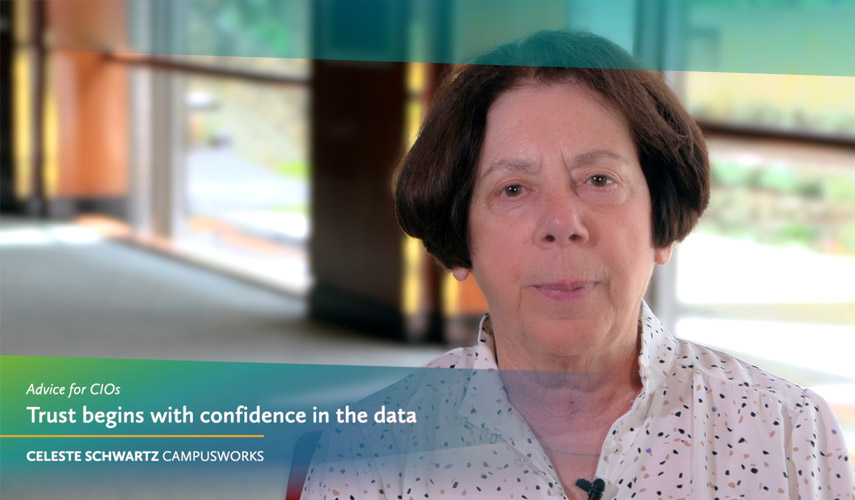
We recently sat down with CampusWorks Executive Advisory Board member Dr. Celeste Schwartz, an award-winning chief information officer, and asked her to share some practical, hard-earned advice for technology leaders navigating one of the most complex moments in higher education. Here we expand on several key themes she raises and explore what they mean for CIOs today.
If you are a CIO grappling with enterprise systems, analytics investments, presidential expectations, or growing fiscal pressure, Celeste’s perspective will resonate. We encourage you to watch the full video below.
Advice from Celeste
Before undertaking any technology initiative, institutions must first understand the data they already have—and ensure it is clean and integrated across systems.
This sounds simple. In practice, it is anything but.
Most institutions operate with:
- Fragmented data across SIS, LMS, CRM, HR, and finance systems
- Inconsistent definitions of key metrics (retention, enrollment, FTE, margin)
- Manual reporting processes and shadow spreadsheets
- Limited integration with external labor market or benchmarking data
Before launching new dashboards, AI pilots, or enterprise transformations, CIOs should ask:
- Do we trust the accuracy of our core datasets?
- Are definitions aligned across departments?
- Can we connect internal performance data with external workforce and market intelligence?
Strategic decision-making requires more than access to data. It requires connected data that leaders believe in.
Leading data and analytics is a journey—and that journey begins with trust.
Trust is not built through a single report or quarterly dashboard rollout. It develops over time through:
- Consistent validation processes
- Transparent data governance
- Cross-functional collaboration
- Clear documentation of definitions and methodologies
CIOs must move beyond report generation. The role is evolving into one of an institutional translator and strategist. Serving up information is not enough. Leaders need help interpreting insights and understanding how to act on them.
That means:
- Explaining trends in plain language
- Connecting analytics to institutional strategy
- Identifying measurable outcomes tied to initiatives
- Creating feedback loops to evaluate progress
The most impactful CIOs are not simply technology operators. They are confidence builders—ensuring presidents, cabinet members, and boards can act decisively because they trust the numbers.
A CIO’s conversations with the president should not center on infrastructure or technical architecture.
Instead, they should focus on value.
Presidents are thinking about:
- Enrollment sustainability
- Financial resilience
- Student success
- Workforce alignment
- Institutional reputation
CIOs strengthen their influence when they translate technology investments into outcomes presidents care about:
- How will this improve retention?
- How will this reduce cost per student?
- How will this support academic program strategy?
- How will this help us respond to demographic shifts?
When data is transformed into actionable insight, CIOs arm institutional leaders with the clarity they need to set a positive course.
The most effective CIOs spend time building a strong partnership with the CFO.
IT is expensive. Modernization, cybersecurity, ERP transitions, analytics platforms—all require significant investment.
A productive CIO–CFO partnership rests on:
- Personal trust
- Transparency around cost structures
- Clear articulation of ROI
- Alignment with institutional mission and measurable outcomes
Rather than defending line items, CIOs should co-create value narratives with CFOs:
- What is the financial risk of inaction?
- How does improved business intelligence support better forecasting?
- Where can automation or integration reduce manual cost?
- How can technology investment drive enrollment or program optimization?
When IT and finance move in lockstep, the conversation shifts from cost containment to strategic enablement.
Before selecting a new ERP, migrating to the cloud, or layering on advanced analytics tools, CIOs should assess, “Where are we today?” as it relates to:
- Current data maturity
- Business intelligence capabilities
- Governance structures
- Organizational readiness
- Cultural appetite for change
Sometimes, the most urgent priority is not replacing an enterprise system—it is strengthening business intelligence so the institution can grow enrollment and improve student success.
Technology decisions made without this self-assessment risk becoming expensive distractions.
Higher education leaders are operating in an environment defined by:
- Demographic headwinds
- Financial constraints
- Heightened regulatory scrutiny
- Escalating cybersecurity threats
- Accelerating AI innovation
CIOs are uniquely positioned to help institutions navigate this turbulence—but only if they step fully into the strategic leadership role.
That role requires:
- Deep understanding of institutional data
- Commitment to data quality and governance
- Ability to translate analytics into action
- Trusted relationships with presidents and CFOs
- Clear-eyed assessment of enterprise readiness
It also requires courage—to say no when technology is not the answer, and to say yes when investment is necessary for long-term resilience
Institutions should consider partners who understand higher education deeply and operate with responsiveness and service orientation, like CampusWorks.
The challenges CIOs face are not generic IT problems. They are mission-driven, enrollment-dependent, regulation-bound, student-centered challenges. Experience matters.

Celeste Schwartz, Ph.D.
Celeste Schwartz speaks from lived experience as a CIO and higher education leader. Her advice is practical, grounded, and especially relevant in today’s climate.
We invite you to watch the full video, reflect on where your institution stands in its data journey, and consider how your role can evolve from infrastructure manager to strategic catalyst.
Because in the end, making data work for your institution is not about dashboards.
It is about leadership.

