





EAB Thought Leadership
Advice for CFOs:
Leading with Trust in Uncertain Times
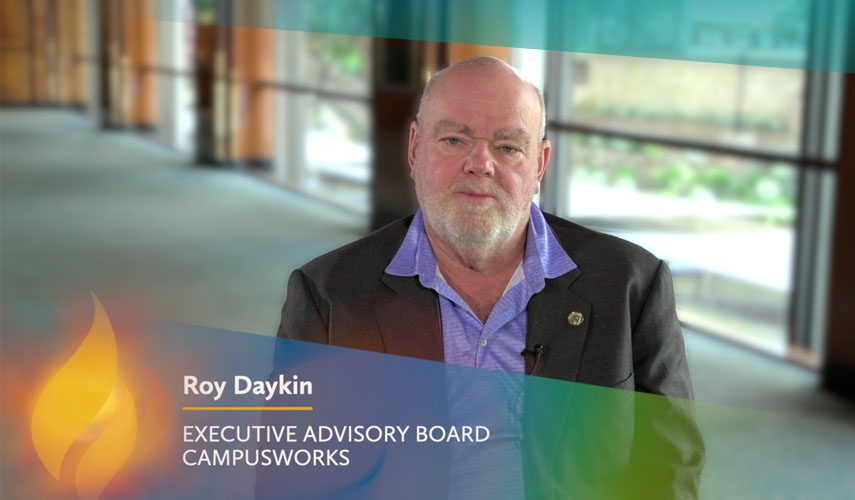
We recently sat down with longtime higher education CFO Roy Daykin—now a member of the CampusWorks Executive Advisory Board—to learn from his experiences leading through economic downturns, institutional transformation, and global disruption. His message is straightforward but powerful: trust is the foundation of effective financial leadership.
If you are a CFO grappling with difficult budget decisions, strategic investments, or institutional uncertainty, Roy’s perspective will resonate. We encourage you to watch the full video.
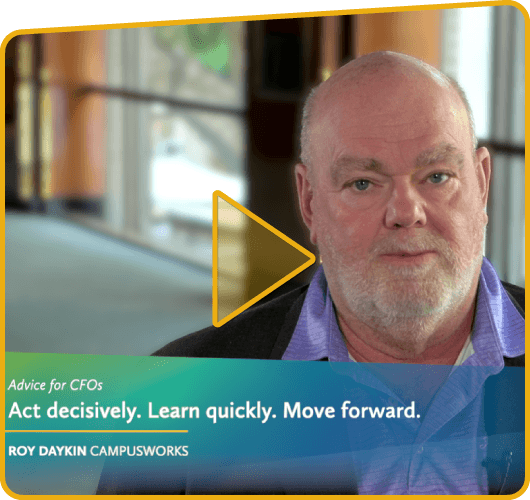
Advice from Roy Daykin
CFOs occupy a uniquely challenging role in higher education leadership. Financial leaders often carry the responsibility of helping institutions chart a path toward long-term sustainability. That frequently requires making tough recommendations that affect programs, staffing, or investments.
Those recommendations will only succeed if trust already exists.
Trust must be built across several critical relationships:
- With the president, who depends on the CFO for clear financial insight and strategic guidance
- With cabinet colleagues, who must understand the financial realities shaping institutional decisions
- With operational leaders, whose cooperation is essential when implementing changes
When financial leaders are trusted, their recommendations carry weight. When that trust is missing, even the most sound financial strategies can stall.
Building trust requires transparency, consistency, and a willingness to explain not just what decisions are needed, but why they matter for the institution’s future.
Institutional challenges should not be viewed solely as problems to solve. They should be treated as opportunities to rethink how the institution operates.
Higher education leaders often fall into a reactive posture—working to fix immediate issues rather than asking deeper questions about the future.
Financial challenges can become catalysts for innovation when leaders ask:
- Are there more sustainable program models?
- Can partnerships expand access or reduce cost?
- Are there new revenue opportunities aligned with workforce needs?
- Can technology streamline administrative processes?
In this mindset, the CFO becomes more than a steward of financial controls. The role evolves into that of strategic architect, helping the institution redesign itself for long-term resilience.
Risk aversion is one of higher education’s biggest challenges today. Decisions are often delayed—or avoided entirely—because leaders fear making the wrong choice.
Ironically, failing to act can be the most consequential decision of all.
In an environment of demographic shifts, evolving workforce needs, and technological transformation, institutions that move too slowly risk losing relevance.
Financial leaders can help counteract this tendency by:
- Encouraging informed experimentation
- Supporting data-driven decision-making
- Creating financial models that allow for controlled risk-taking
- Framing investments as strategic bets rather than binary choices
Progress rarely comes from perfect decisions. It comes from timely decisions followed by continuous learning.
Institutions that navigate disruption successfully often do so by trusting the people closest to day-to-day operations.
Empowering decision-makers across the organization creates several advantages:
- Faster responses to emerging challenges
- Greater accountability at operational levels
- Increased innovation from frontline leaders
- Stronger institutional resilience
For CFOs, this means creating financial frameworks that support responsible autonomy. Leaders should have the authority to act—without fear that imperfect outcomes will be punished.
A culture that punishes thoughtful risk-taking inevitably slows progress.
Too often, institutions rely on consulting partners that provide standardized solutions that fail to account for the complexity of their environments.
The most effective partnerships begin with listening.
Every institution operates within its own ecosystem of:
- Mission and culture
- Student demographics
- Funding structures
- Regulatory environments
- Community expectations
Understanding the root causes of financial or operational challenges requires careful exploration before solutions are proposed. Only then can leaders move beyond short-term fixes and identify opportunities that advance the institution.
Institutions that emerge stronger from crises and disruption do so because their leadership teams trust one another and empower people to act.
For today’s CFOs, that leadership mindset is more important than ever.
Financial sustainability will not come solely from cost-cutting. It will come from:
- Strategic investments
- Strong cross-functional collaboration
- Clear-eyed assessment of institutional realities
- Courage to act decisively when opportunities arise
In uncertain times, financial leadership is not just about protecting the institution’s balance sheet.
It is about helping the institution move forward.
Institutions should consider partners who understand higher education deeply and operate with responsiveness and service orientation, like CampusWorks.
The challenges CIOs face are not generic IT problems. They are mission-driven, enrollment-dependent, regulation-bound, student-centered challenges. Experience matters.

Roy Daykin
Watch the Full Conversation
Roy Daykin’s advice reflects decades of real-world leadership in higher education finance. His perspective offers valuable guidance for CFOs who must balance fiscal responsibility with institutional transformation.
We encourage you to watch the full video and consider how the principles he describes—trust, decisiveness, and opportunity-focused leadership—can help your institution navigate the road ahead.

